
We Must Stop Treating Burnout as a Mindset Issue (It’s a Cellular Emergency)
When a senior female leader in tech starts to crash, the corporate response is almost always psychological. Resilience workshops. CBT apps. Mandatory mental health days. Reframe your stress. Be more mindful. The message underneath all of it: your burnout is a failure of mindset. Think differently and you'll handle the pressure.
For neurodivergent women, that message isn't just unhelpful. It's biologically dangerous.
As a metabolic health consultant working with senior neurodivergent women in tech, I watch this approach do damage every week. Burnout in the neurodivergent brain isn't a mindset issue. It's a cellular emergency.
The Corporate Gaslighting of Neurodivergent Women
Tech companies recruit neurodivergent women precisely for the out-of-the-box thinking, hyperfocus, and pattern recognition that comes with a different kind of brain. Then they ask those brains to survive inside a neurotypical structure that requires constant sensory and social masking just to get through the day.
When performance slips because she's neurologically exhausted, the fix on offer is a productivity tracker. Nobody asks whether her nervous system is misfiring under sensory overload. They assume she's lacking willpower.
Consistency is a neurotypical myth. The neurodivergent brain runs in cycles, not straight lines. Ask her to push harder when she's already depleted, and you don't get more output. You get another burnout cycle, deeper than the last.
The Deep Biology of Burnout
What most HR departments and GPs miss: neurodivergent burnout isn't a masking problem. It's metabolic.
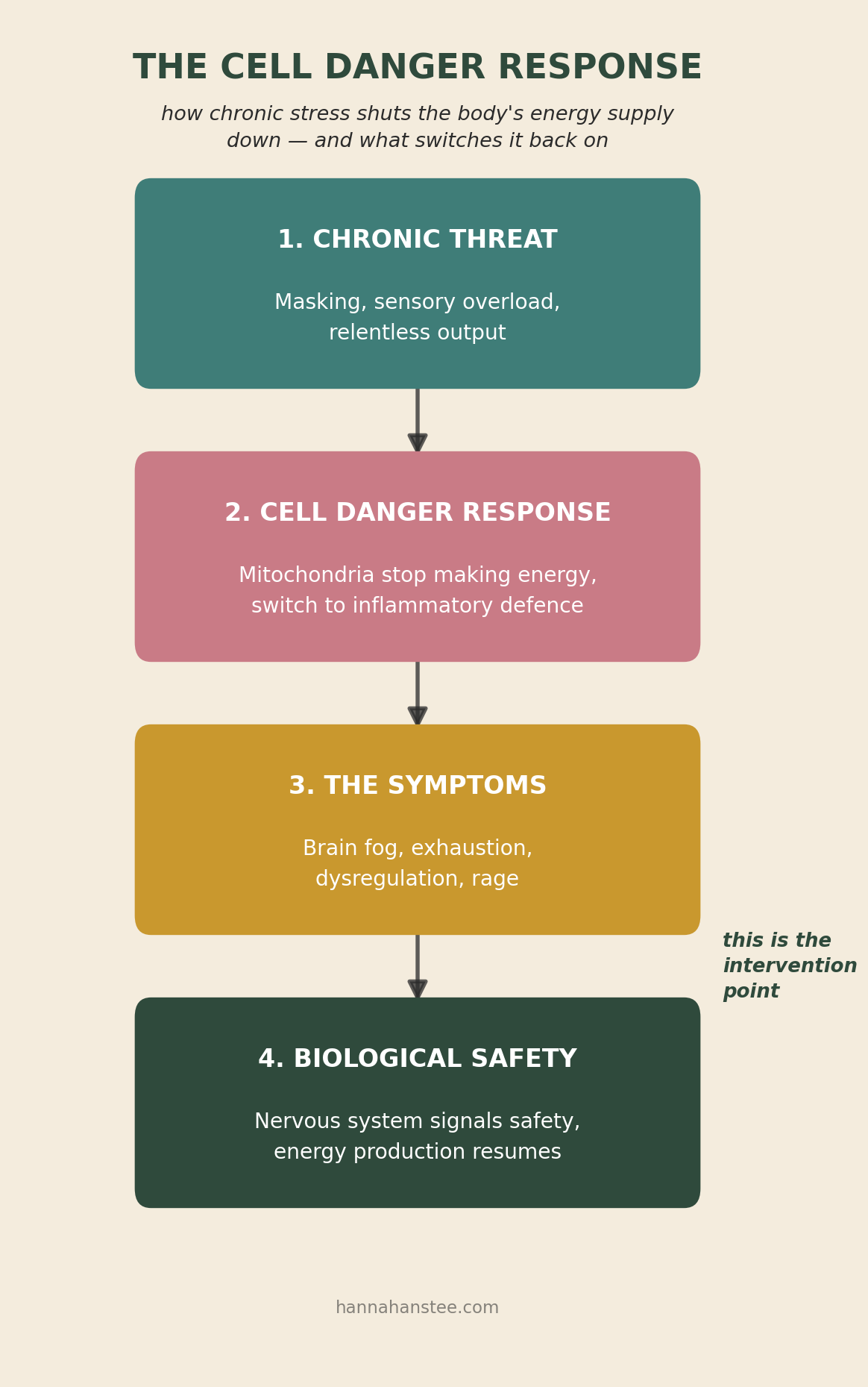
When a nervous system absorbs chronic stress from masking and sensory overload, the mitochondria — the cell's energy producers — change how they behave. Dr Robert Naviaux named this the Cell Danger Response: a cell that feels chronically under threat stops producing energy and switches into an inflammatory, protective shutdown instead.
From the outside, this looks like a woman losing her edge, or sliding into depression. She might be asking herself whether this is actually a mental health problem, or something else entirely.
Often it's something else. Brain fog, exhaustion, and cognitive slowdown can be signs of mitochondrial dysfunction and insulin resistance, not just stress. Telling a woman in that state to shift her mindset is like telling someone to meditate their way out of a fracture.
Autistic Rage Is Not a Failure of Resilience
Under chronic Cell Danger Response, the nervous system loses its capacity to self-regulate. Things that used to be manageable become unbearable. Frustration turns explosive. What follows is often deep shame, and something I regularly see described — and dismissed — as "autistic rage."
The corporate world doesn't make room for that kind of dysregulation, so she suppresses it. Suppression takes cortisol and adrenaline. Both push her insulin sensitivity further down and lock her deeper into metabolic shutdown. She's being penalised for a biological symptom her environment created.
The Midlife Breaking Point
This gets worse at perimenopause — what I call the second puberty, when ADHD and autistic traits intensify and oestrogen drops. Oestrogen regulates dopamine and serotonin. Lose it, and the neurodivergent brain loses its main coping mechanism.
The mask comes off completely. She can't push through the physical pain anymore. That's the moment a manager suggests a resilience seminar — asking her to out-think a hormonal and cellular collapse.
The Antidote: A Biological Strategy
If companies want to keep their most valuable female talent, mindset hacks for metabolic deficits won't cut it.
A depleted neurodivergent nervous system doesn't need resilience training. It needs biological safety. In my practice, we don't force metabolism back online — we invite it. We look at sensory load, circadian rhythm, and metabolic fuel. We match protein and fat to stabilise glucose, build sensory budgets that stop the energy leaks, and align light exposure to her actual sleep rhythm instead of a generic one.
Only once the Cell Danger Response switches off does her executive function, focus, and energy come back.
Stop treating her mind as broken and start treating her environment as biologically unsafe, and you're not managing burnout anymore. You're turning the lights back on.
How We Can Work Together
For corporate leaders: rebuilding resilience in your senior female talent requires a sustained strategy. If you want to retain your neurodivergent leaders through my bespoke Corporate Retention Programmes — while funding metabolic healthcare for local Khmer women through your CSR budget — book a complimentary 20-minute Biological Retention Chat here to discuss your goals.
For ND women in burnout right now: if you're a peri/menopausal woman currently suffering from 3am wake-ups, brain fog, or chronic exhaustion, and you want a targeted biological intervention, you can read the full details and secure your Forensic Metabolic Assessment directly through this link.
